

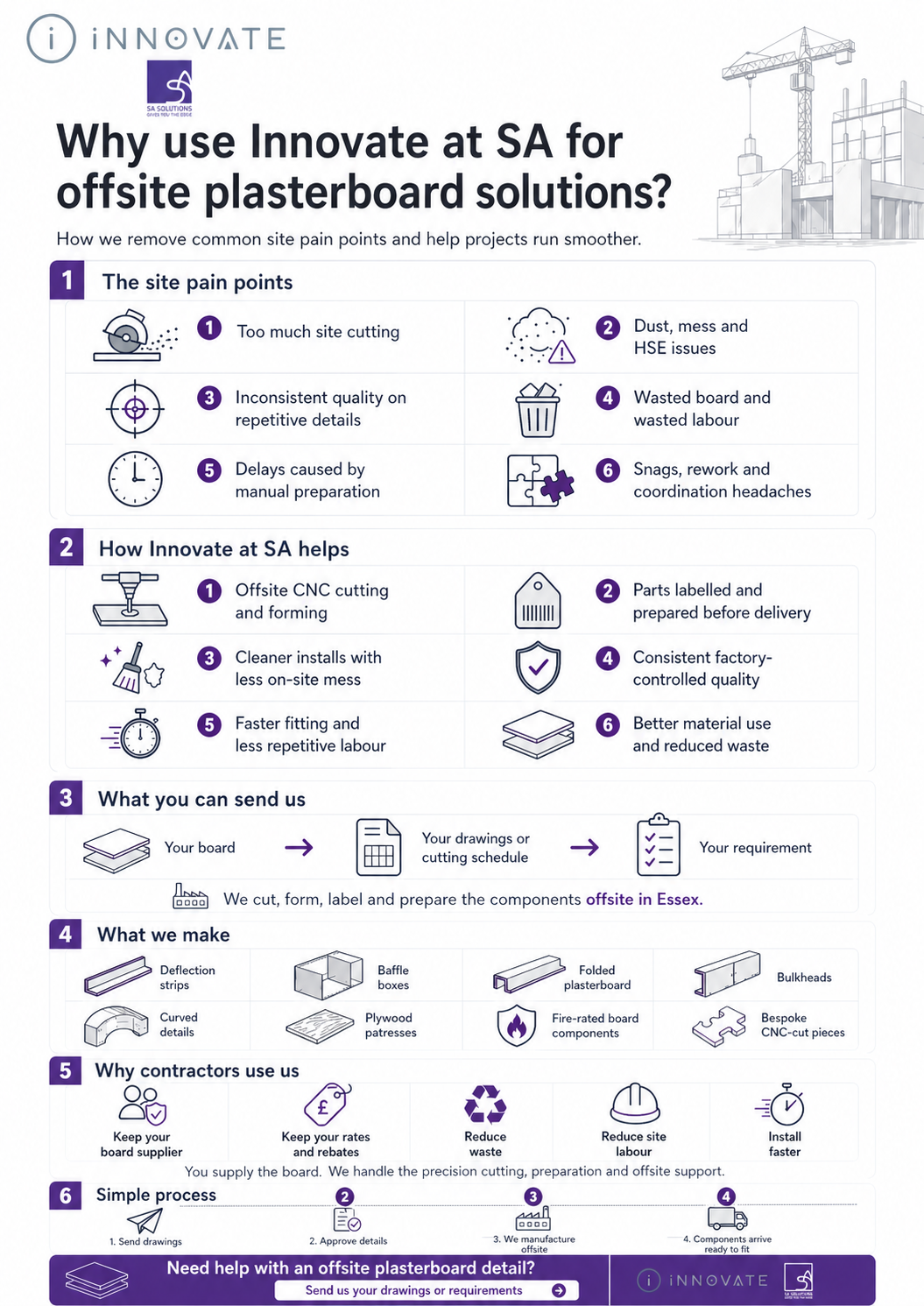
Site should not be the factory
If your drylining team spends half the day cutting board on site, you do not have a plasterboard problem. You have a process problem.
That does not mean the site team is doing anything wrong. It usually means the team has left too much preparation until the job is already live, busy and under pressure.
That is where Innovate at SA comes in. We take the plasterboard preparation that slows sites down and move it into our offsite facility in Essex.
You send us your board, your drawings, your cutting schedule or the awkward detail that is already making people nervous. Then we cut it, form it, label it and prepare it before it reaches the project. As a result, your team gets something ready to fit, not another pile of board to wrestle with.
The work we take off site
Some of the work is boring but important. Pre-cut deflection strips, rips, repetitive cuts, fire-rated board components and board preparation that must hit the right dimensions every single time.
Other work is awkward. For example, baffle boxes, preformed plasterboard bulkheads, folded plasterboard, ceiling features, lighting details, curved work, column details and bespoke CNC-cut pieces all require careful planning before anyone picks up a blade.
Both types burn time on site when teams leave them too late. The boring work slows people down because there is so much of it. The awkward work slows progress because it needs thinking through carefully before anyone starts cutting. We help with both.
Your board. Our cutting.
Here is something important: you can send us your own board. We are not here to interfere with your supplier, your merchant rates or your rebates. You keep all of those.
Instead, we simply handle the cutting, forming, labelling and preparation. That means your team is not trying to turn full sheets into strips, boxes, curves, bulkheads or special details in the middle of a live project. Getting on with the fitting becomes the priority. That is the point.
Why leaving it to site causes problems
Site cutting does not just create dust. It creates disruption. Boards pile up in the wrong places, cutting stations consume valuable space, offcuts accumulate and operatives damage materials. Labour pours into repetitive work, and details vary from one operative to the next.
Then the knock-on problems start:
- Rework and snagging.
- Programme pressure and delays.
- Wasted materials and budget.
- Frustrated teams and the classic “who cut that?” conversation.
Nobody needs more of those. Moreover, if your team can prepare a component accurately off site, why leave it to chance on site?
How we work
The process starts with what you have. That might be a drawing, a cutting schedule, a marked-up plan, a sketch or a conversation about what you are trying to achieve. We look at the detail and work out the practical route - how to cut it, form it, label it, pack it and install it, and where it could go wrong on site.
If a complex detail needs it, we 3D model the job so everyone understands the intent before we make anything. After that, we manufacture off site: cutting, nesting, forming, folding, drilling, labelling and packing the components in a way that makes sense for the job. The aim is not to make the process fancy. The aim is to make site easier.
Betterment without the waffle
Betterment is one of our core values, but not in a corporate poster kind of way. We mean genuinely looking at every job and asking whether we can do it cleaner, cut it more accurately, generate less waste, save labour and make life easier for the installer. In short, we ask whether it gives the contractor more control before the work reaches site.
Sometimes the improvement is small. In other cases, it changes the way a team delivers a detail entirely. Either way, the idea stays the same: do not keep doing something the hard way just because that is the tradition.
Consistency is where the value starts
Site-made details vary. That is not an insult - it is reality. Different people, different tools, different pressures and different results. Offsite plasterboard solutions give you more control, because your team cuts the same detail the same way, labels it the same way and packs it in a logical sequence. As a result, the site team gets a much better starting point.
Furthermore, offsite preparation helps reduce the small errors that become bigger problems later. Value is not just about the cheapest cut. It is about what happens when the component reaches site. A good offsite solution saves time, reduces waste, removes a cutting station, cuts rework, helps the programme and frees skilled labour from repetitive cutting. That is where offsite plasterboard solutions earn their place.
Who this helps
Site managers get fewer cutting stations, less dust, less mess and fewer small problems to police every day.
Project managers benefit from fewer avoidable delays stacking up across the programme. Commercial teams gain better control of waste, less damaged material and less labour tied up on repetitive cutting.
Installers receive prepared components that make sense when they arrive, instead of another pile of board and a problem to solve. Contractors overall get a cleaner route from drawing to installation.
Assistance is part of the service
We are not just waiting for a spreadsheet. Yes, we work from a cutting schedule. However, we can also help earlier than that. If you have an awkward detail, send it over. If something looks simple on a drawing but painful on site, we have probably seen a version of it before.
Since 2008, we have dealt with site problems directly. That experience matters because a good offsite solution has to work in the real world. Someone has to make it, pack it, deliver it, move it, lift it, fix it and finish it. If it creates a new problem on site, it is not a solution.
Less site stress
The goal is simple: less cutting on site, less dust, less waste, less repetitive labour, less variation and less rework. In short, more control before the job reaches the project.
That is what Innovate at SA stands for. We take the board preparation that slows sites down and deal with it off site. Consequently, your team can focus on fitting, finishing and moving the job forward.
Got a plasterboard detail slowing the job down?
Send it over. It might be pre-cut deflection head strips, baffle boxes, bulkheads, deflection head strips for London projects, folded plasterboard, ceiling details, lighting details, curved work, fire-rated board components or something awkward that nobody really wants to cut on site.
If we can help, we will tell you. If there is a better way to make it, we will tell you that too.
To find out more about what we make, visit our deflection strips product page, our plasterboard cutting service or our baffle box page. You can also browse the Knowledge Hub for more technical guidance.
Ready to talk? Get in touch with us here - call 01279 216175 or email info@innovateatsa.co.uk. We aim to respond the same working day.
Innovate at SA - Your board. Our cutting. Less site stress.
