

If you’re drylining, you already know the deflection head detail has to be right. The strips that line the head are a small job that causes big problems when they’re wrong. And on most sites they’re still being cut by hand, on the deck, in the middle of everything else going on that day.
There’s an easier way. Send us your board, we cut the strips to size, and you fix them. No saw on site, far less dust, and a neater job. Here’s how to get it right, and why off site cutting takes the grief out of it.
What the deflection head actually does
Quick refresher. The deflection head sits at the top of the partition where it meets the structure above. The floor or roof moves under load, and the wall below has to take that movement without the load coming down onto the studs. The telescopic head lets the structure move up and down while the partition stays sound.
The plasterboard strips that line the head are part of what makes that work. Get them wrong and you’ve got load on the studs, cracked boards, and a failed fire or acoustic line. None of which you want coming back to you on the snag list.
Where it goes wrong
British Gypsum’s own guidance lists the usual faults: boards not cut short enough to let the head move, the wrong board used as a fillet under the track, and packing that fouls the movement gap. Almost all of it traces back to one thing. Strips cut quick by hand, under pressure, with a tape read across a dusty board on the floor.
Cut them accurate and the same every time, before they get near site, and that whole list of problems just goes away. The detail is only as good as the bits going into it.
Send us the board, we cut it for you
Simple as it sounds. You send us your board, we cut your deflection head strips to the widths you need, and they come back boxed in order, ready to fix to the channel.
That means your lads aren’t stopping to measure, mark and cut between every other task. The hours you’re paying skilled trades for go into fixing, not making bits that we can make faster and straighter off site. Over a floor, over a job, that time adds up fast.
It takes the guesswork out too. A strip cut in our place is the same every time. You’re not relying on whoever picked up the saw that morning.
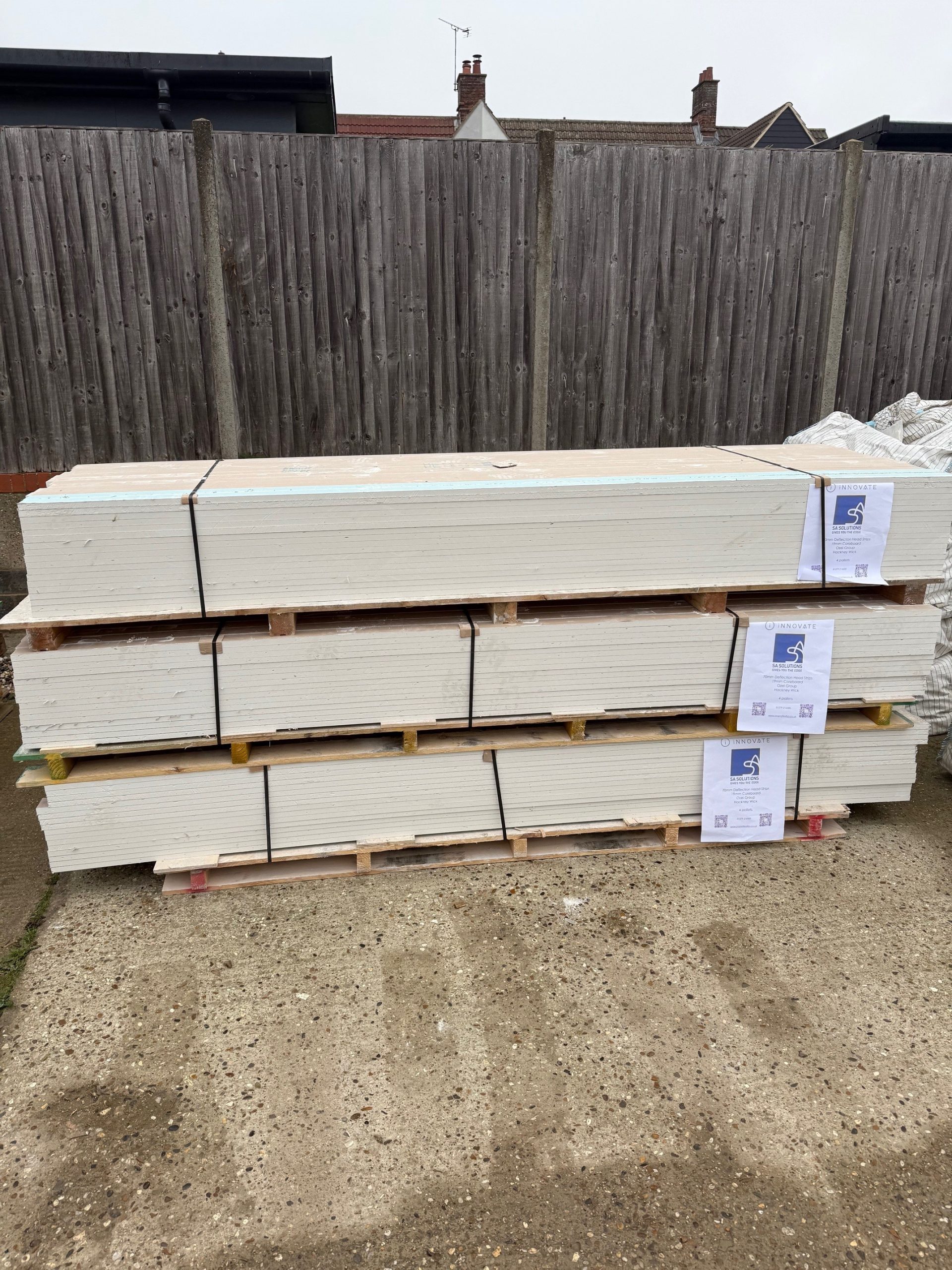
We cut the tricky boards too
It’s not just standard board. We cut Fireline (firecase), Coreboard, and the rest of the awkward ones that are a pain to cut clean on site. Fire board and the dense stuff blunts blades and kicks out the worst of the dust, so it’s exactly the sort of thing worth sending to us. Same board you’re already using, cut to size, sent back ready.
Which board type should you use?
The board going into a deflection head detail isn’t one-size-fits-all. Specifiers and main contractors increasingly check this, and the wrong board type in a fire-rated or acoustic partition is a snag waiting to happen. Here’s a quick guide to the three board types we cut most often for deflection head strips.
Fireline board
Fireline (also referred to as firecase or fire board) is used anywhere the partition needs to achieve a fire rating – typically 30, 60 or 90 minutes. It’s a denser board with glass fibre reinforcement, which is exactly what makes it a pain to cut on site: it blunts standard blades quickly and throws out fine silica-laced dust. The deflection head strips in a fire-rated partition must match the board type used in the main body of the wall, or you’ve compromised the fire line. We cut Fireline regularly and have the tooling set up for it.
Coreboard
Coreboard is a thick, high-density board used in shaft walls, service risers and stair enclosures – anywhere you need structural rigidity in the lining itself. It’s heavy and awkward, and cutting it square on site is genuinely difficult. The strips used in a Coreboard deflection head need to be cut accurately because the tight tolerances in a shaft wall detail leave no room for a rough cut. We cut Coreboard to width for deflection head applications as standard.
Soundblock / acoustic board
Soundblock is the board of choice when the partition has a dB rating to hit. It’s heavier than standard wallboard and the density that makes it good at blocking sound also makes it harder to cut cleanly by hand. In an acoustic partition, the deflection head detail is part of the acoustic seal – so the strips need to be the right board, cut to the right width, with no gaps that let flanking noise through. Standard wallboard should not be substituted here.
Not sure which board type you need? Send us the spec or the drawing reference and we can advise.
Less dust, and a cleaner HSE story
Cutting board on site makes dust, and dust is the thing the HSE pushes hardest on right now. They want it controlled at the source, not a dust mask handed out as an afterthought. The simplest way to cut the dust your crew breathes is to cut fewer bits on site in the first place.
Move the cutting off site and that dust is gone from the work area. Better for your lads, and a far stronger answer when the principal contractor asks how you’re handling dust on your RAMS. “We don’t cut these on site” beats “we wear masks when we do” every time. It’s the kind of thing that gets you noticed on a tidy, well run job.
Less cutting also means less mess, fewer offcuts to clear, and a tidier deck. Cleaner site, safer site.
In a hurry? Have a brew while we cut
Here’s a real one from last month. A fit out crew were stuck, needed deflection head strips that day or the job stopped. They rang, drove over to us in Essex, and we cut their strips while they had a cup of coffee in reception. Twenty minutes later they were back in the van with the strips boxed up, and back on site the same afternoon.

That’s the bit people don’t expect. If you need it fast and you’re nearby, you don’t have to wait on a delivery. Come and get it. We’ll put the kettle on.
Collection and delivery, your call
Most of the time you won’t be in a rush, so we’ve got collection and delivery sorted. So you send us your board with your preferred supplier, we cut it, and get the strips back to you, all in one arrangement. Our place is in Essex (Old Mill Farm, Stansted Road, Elsenham, Essex CM22 6LL), handy for sites across the region. Or do what the crew above did and collect in person if you’re stuck.
We’re FIS members
For what it’s worth, we’re members of the FIS (the Finishes and Interiors Sector), so we know the detail and the standards your job’s being held to. We’re not just cutting board, we know why the deflection head matters and what good looks like.
Frequently asked questions
How wide should deflection head strips be?
The standard width for deflection head strips is typically 25mm, but this depends on the track depth and the specific detail being used. British Gypsum’s C Stud system, for example, specifies a fillet board width to suit the track profile. The important thing is that the strip fills the track cleanly without fouling the movement gap – which is why strips cut 5mm oversize on site cause problems. We cut to whatever width your detail calls for; just send us the drawing or spec.
Can I use standard wallboard on a fire-rated partition?
No. If the partition has a fire rating, the deflection head strips must be Fireline (or equivalent fire-rated board) to match the rest of the partition. Using standard wallboard in a fire-rated detail breaks the fire line and means the partition won’t perform to the specified rating. This is one of the most common non-conformances picked up on acoustic and fire inspection.
Does the deflection gap size matter?
Yes, it matters a great deal. The deflection gap – the space between the top of the board and the head of wall track – is what allows structural movement to occur without loading the studs. British Gypsum’s guidance specifies a minimum 10mm gap in most standard details, but this increases for taller partitions or structures with greater anticipated movement. Boards cut too long that reduce this gap are a common cause of cracked boards and failed acoustic or fire lines further down the line.
What is the difference between a deflection head and a standard head of wall?
A standard head of wall fixes the partition rigidly to the structure above. A deflection head is designed to allow vertical movement – the track slides telescopically so the structure can move (through loading, thermal movement, or slab deflection) without transferring that load into the partition or the board. Deflection heads are required under current British Gypsum guidance for most multi-storey and commercial partitioning, particularly where slab-to-slab movement needs to be accommodated. This is one of several interface details where fire-rated partitions run into trouble — see our guide on fire-rated partition interfaces.
How do I order pre-cut deflection head strips?
Send us your board type, the strip width you need (from your drawing or specification), and the quantity. If you’re not sure of the strip width, send us a section of the drawing and we’ll work it out. We’ll cut, label and box the strips ready to fix, and arrange collection or delivery to suit your programme. You can call us on 01279 216175 or use the contact form on our deflection head strips page.
The short version
Accurate strips, cut off site, mean fewer faults in the deflection head. Less cutting on site means less dust and a cleaner HSE story. Boxed in order means a faster fix. Fireline, Coreboard and the tricky boards sorted. Collection and delivery to suit you, or come and collect while we cut. And your skilled lads spend their time fixing, not making bits on the deck.
The detail still has to be right. We just make the right way the easy way.
Need strips for your next job?
Send us a bit of your board and the widths you’re after, and we’ll cut, box and get them back to you ready to fix. Stuck and need it today? Give us a ring and come and collect, the kettle’s on.
See our deflection head strips service
We deliver deflection head strips across the UK – view our UK delivery areas
