

Getting pattress boards cut to size offsite removes one of the most repetitive and time-consuming tasks from a busy site.
When pattresses are missing, wrong or badly positioned, everyone knows about it. When they are right, they are invisible.
A pattress is a backing piece that provides fixing support behind a finished surface.
Common uses include access panels, brackets, handrails, signage, sanitaryware, joinery, MEP equipment and other project-specific details.
On paper, that sounds simple.
On site, it is rarely that simple.
The problem with pattresses on a busy site
A single pattress is not difficult.
The problem starts when a project needs hundreds of repeated backing pieces across different rooms, zones, corridors, risers or service areas.
Each piece needs measuring, cutting, checking and installing in the right place, one at a time.
That takes time.
It also creates dust, waste, noise, manual handling and pressure on the site team.
If the work is being done in a tight space, under programme pressure, the risk of mistakes increases.
That is why repeated backing details are a good example of where offsite preparation can help.
Mace at Manchester Airport
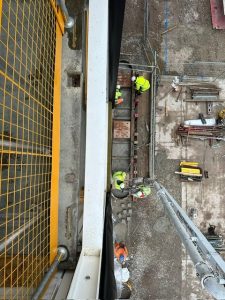
Innovate at SA supported Mace at Manchester Airport with offsite pattress preparation. Airport work brings its own pressure. Access is controlled. Working windows are tight. Deliveries need planning. Dust and waste need managing carefully.
On this project, the stakes were even higher.
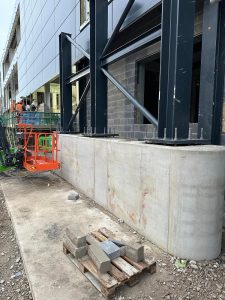
Every time a bridge section was lifted into position, there was only a four-hour possession window to complete the operation.
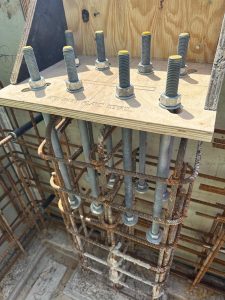
If the anchor bolts did not line up perfectly with the bridge bearings, the lift failed. The crane stood down while the team removed the bridge, ending the possession.
They then had to book a new lift.
Every failed lift cost tens of thousands of pounds.
It happened repeatedly.
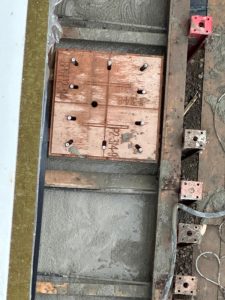
The solution was precision before concrete was poured.
We manufactured CNC-machined bolt templates from the engineer’s drawings.
These were installed before the concrete pour, eliminating the misalignment that was causing each failure.
Instead of sending full sheets to site and asking the installation team to measure and cut every piece under pressure, components arrived ready to install.
How pattress boards cut to size are prepared offsite
The contractor sends us the board, drawings, schedules or template information.
We review the requirement and check the detail before production.
Where needed, we can model the detail or prepare templates so the fit can be checked before the full batch is cut.
Once the detail is confirmed, we nest the material to make better use of the board and reduce unnecessary waste.
We then cut the components offsite, label them clearly and prepare them so they can be issued to site in a controlled way.
The site team receives parts that are ready to fit.
If you want to see this process in person, you are welcome to visit our Innovation Center in Essex.
Bring your drawings or an awkward detail and we will show you how it can be prepared offsite.
What materials can be used?
Pattresses can be made from different sheet materials depending on the fixing requirement and project specification.
Common materials include plywood, plasterboard-based backing pieces, fire-rated boards, cementitious boards, specialist sheathing boards and other specified sheet materials.
The correct material depends on what the pattress needs to support, where it sits in the wall or ceiling build-up, and whether there are fire, acoustic, moisture, impact or fixing requirements.
At Innovate at SA, the contractor keeps control of the board and the specification.
They can send us their own board or specified sheet material.
We then take away the cutting, preparation, labelling, dust and waste from site.
For non-standard requirements, our bespoke solutions service covers components that do not fit a standard product range.
The real saving
The saving is not always in the price of the board. The saving is often in everything around the board.
Less site cutting.
Dust, waste and prep time diminished.
Lower pressure on labour.
Better use of material.
More consistent components.
A cleaner and simpler install for the site team.
For time-critical sites, that matters.
At Manchester Airport, consistent first-time bridge installations replaced repeated costly failures.
The smallest component protected the biggest programme.
A small detail with a big site impact
Pattresses may be hidden at the end of the job, but they have a real impact on programme, quality and coordination.
When they are prepared properly, they help the next trade do their job.
If they are missed or wrong, they create delay and rework. Its painful!
That is why offsite preparation is not just about cutting board.
It is about giving the site team a better starting point.
If you have a project with repeated pattress details, backing pieces or cut sheet components, send us your board, drawings or schedule.
We will review what can be prepared offsite and help turn the requirement into labelled, site-ready parts.
